What is B. Com FinTech
The B. Com FinTech is an innovative undergraduate program designed to bridge the gap between traditional commerce and emerging financial technologies. The course equips students with a strong foundation in accounting and finance while integrating modern technological concepts such as digital banking, blockchain, artificial intelligence, data analytics, and financial modelling.This program aims to develop industry-ready professionals who can adapt to the rapidly evolving financial ecosystem. Students gain practical exposure through case studies, projects, internships, and hands-on training with fintech tools and platforms.
The curriculum focuses on developing analytical, technical, and decision-making skills, enabling graduates to pursue careers in areas such as banking, investment analysis, financial consulting, fintech startups, digital payments, and regulatory technology.
By combining commerce with cutting-edge technology, the B. Com FinTech program prepares students to become future leaders in the digital financial world.
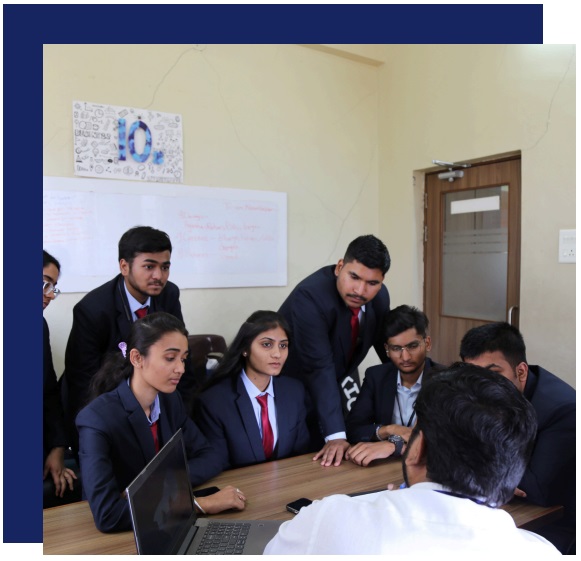
Why choose B.Com FinTech:
- Future-Oriented Program
- High Industry Demand
- Practical & Skill-Based Learning
- Diverse Career Opportunities
- Strong Foundation in Commerce & Technology
- Entrepreneurship Opportunities
- Global Relevance
PROGRAMME DURATION
3 years
INTAKE CAPACITY
80 Students
PROGRAM FEE PER YEAR
Rs. 80,000
It is prepared as per National Education Policy Structure
*ELIGIBILITY
12th EXAMINATION (10+2)
Eligibility of a candidate for admission is Higher Secondary School Certificate (10+2) or its equivalent Examination with English.
OR TWO YEARS DIPLOMA
Two-Year Diploma in Pharmacy after HSC, of the Board of Technical Education conducted by the Government of Maharashtra or its equivalent.
OR THREE YEARS DIPLOMA
Three-Year Diploma Course after S.S.C., i.e., 10th standard, of the Board of Technical Education Conducted by the Government of Maharashtra or its equivalent.
INTERMEDIATE COMMERCE/ARTS EXAMINIATION
Intermediate Commerce/Arts examination from the Board of Secondary Education, M.P. Bhopal with 4 subjects, including General English. H.S.C. Vocational.
Program Objective:
CAREER OPPORTUNITIES
Core Finance + FinTech Roles
Technology-Oriented Roles
Banking & Financial Services
Emerging FinTech Domains
Government & Regulatory Careers
Entrepreneurship Opportunities
Infrastructure & Facilities
Computer labs
FinTech labs
Library resources
Software tools (Excel, Tally, Power BI, SAP etc.)
Admission Process
- Fill Application Form
- Appear for Entrance Examination
- Selection Process as per Merit List
- Document Verification
- Fee payment & admission confirmation
LEARNING SYSTEM
Financial & Analytical Skills
Strategic & Analytical Thinking
Teamwork
Digital & FinTech Expertise
Data Analytics & Financial Modelling

Technical & Technology Skills
Problem-Solving & Decision-Making
Communication & Professional Skills
Industry Readiness
College-Level Entrance: Candidates are required to appear for a College-Level Entrance Examination conducted by MES Garware College of Commerce. Admission will be based on – 50% Weightage in Entrance Exam, 50% Weightage based on 12th Percentage.
Entrance Exam Date: 19th June 2026
Entrance Exam Time: 11:00 AM
Entrance Exam Fee: Rs 200
Entrance Exam Enrollment Date: Up to 16th June 2026 up to 11:59 pm
Entrance Exam Mode - Online Mode.;
Candidate will register for the Entrance Examination through the provided link, which will be starting from 11th June 2026 to 16th June 2026, 11:59 pm.
Syllabus & Content of Entrance Exam for B. Com (FinTech)
Conducted by:
MES Garware College of Commerce (Autonomous) is designed to assess a student’s Aptitude in Analytical thinking, Technology, Finance and general awareness. The syllabus is broadly divided into the following sections:
- English Language / Verbal Ability (40 Marks)
Focuses on evaluating language proficiency and comprehension skills.
Topics Covered:
- Grammar (tenses, articles, prepositions)
- Vocabulary (synonyms, antonyms)
- Idioms and phrases
- Sentence correction and completion
- Reading Comprehension (passage-based questions)
- Para jumbles
- Logical Reasoning & Analytical Ability (30 Marks)
Tests the ability to think logically and solve problems efficiently.
Topics Covered:
- Coding-Decoding
- Series (number, alphabet, alphanumeric)
- Blood Relations
- Direction Sense Test
- Syllogisms
- Puzzles & Seating Arrangements
- Venn Diagrams
- Data Sufficiency
- General Knowledge & Current Affairs (10 Marks)
Measures awareness of current events and general knowledge.
Topics Covered:
- National & International Current Affairs
- Business & Economic Awareness
- Indian History & Geography
- Indian Polity & Constitution
- Science & Technology
- Sports & Awards
- Basics of Computer & Finance (20 Marks)
- I) Basics of Computer:
- Fundamentals of Computers
- Definition and types of computers
- Basic components: Input, Output, CPU, Memory
- Hardware vs Software
- Generations of computers
- Operating Systems
- Basics of operating systems (Windows, Linux)
- File and folder management
- Basic system operations (copy, paste, delete, rename)
- Internet & Digital Awareness
- Internet basics and uses
- Web browsers and search engines
- Email (sending, receiving, attachments)
- Cyber safety and security basics
- Basic Computer Terminology
- RAM, ROM, CPU, URL, HTTP, Software, Hardware
- Input/Output devices
- II) Basics of Finance:
- Introduction to Finance
- Meaning and scope of finance
- Types of finance (personal, business, public)
- Banking Basics
- Types of bank accounts (Savings, Current, FD, RD)
- Basic banking operations
- Digital banking (UPI, Net Banking, Cards)
- Accounting Fundamentals
- Basic accounting concepts
- Types of accounts
- Introduction to journal, ledger
- Profit & Loss and Balance Sheet basics
- Financial Awareness
- Inflation and interest rates
- Simple & Compound Interest (basic understanding)
- Budget and savings concepts
- Business & Economy Basics
- Demand and supply
- Types of markets
- Basic economic terms
Applicants preparing for the Entrance Examination are advised to refer to standard study material covering English Language, Logical Reasoning, Quantitative Aptitude, General Knowledge, Computer Basics, and Finance Basics.